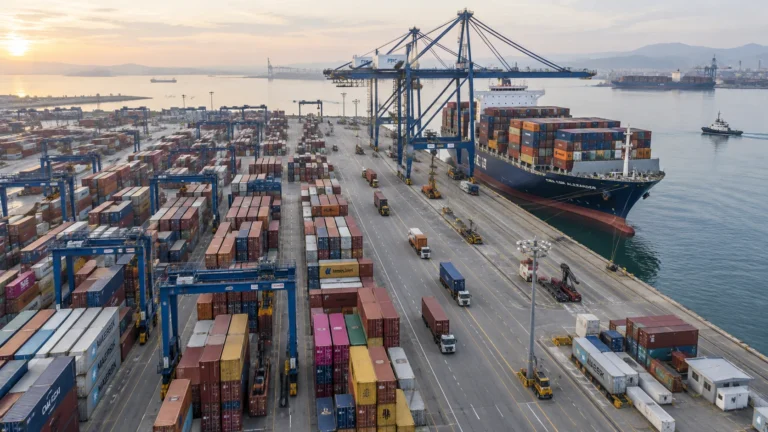
The exporter of record (EOR) is the company or person legally responsible for goods leaving a country. It makes sure the goods are allowed to be exported, that they are declared correctly and that any export licence they need is in place. If the export authorities later find a problem with the shipment, the exporter of record answers for it.
The role covers the origin end of a shipment. At the destination, the same job is done by the importer of record, who answers to customs in the country where the goods arrive.
- Every export has an exporter of record, even if the contract does not name one.
- In most sales the exporter of record is the seller.
- The exporter of record usually has to be registered in the country the goods leave.
- A freight forwarder can file the export paperwork, but that does not release the exporter of record from its legal responsibility.
Exporter of Record Responsibilities
The exporter of record is responsible for checking that the goods can legally leave the country, declaring them correctly to the export authorities, keeping the export records and answering for any errors after the goods have shipped.
- Export licences and sanctions. Some goods need an export licence because of what they are, where they are going or who will use them. This applies to military goods and to dual-use items, which have both civilian and military uses, such as certain encryption equipment, drones and chemicals. The buyer and the end user also have to be checked against sanctions lists.
- The export declaration. The goods are declared before they leave, with a description, commodity code, value and destination. In the European Union this is an export declaration in the customs system. In the United States it is Electronic Export Information filed in the Automated Export System, generally required when a shipment includes more than $2,500 of goods under one commodity code or when the goods need an export licence.
- Commercial documents. The commercial invoice, the packing list and, where needed, the certificate of origin must match the goods and each other. Customs at the destination clears the goods using the same documents.
- Records. Export documents must be kept for a period set by law. Under US export regulations it is five years.
- Liability after shipment. If goods left without a licence they needed, or were declared incorrectly, the exporter of record can be penalised, even when a freight forwarder filed the declaration.
The exporter of record does not have to be the manufacturer or the party paying for transport. The sales contract and the agreed delivery terms decide that.
Who Is the Exporter of Record?
In most sales the exporter of record is the seller. The role can also fall to a trading company, to the buyer under Ex Works terms or to a third-party exporter of record service. Whoever takes it normally has to be registered in the country the goods are leaving.
- The seller or manufacturer. The company that sells the goods exports them in its own name. This is the usual case.
- A trading company or distributor. When a manufacturer sells through a trader, the trader is often the exporter, because it is the party selling the goods abroad.
- The buyer. Under Ex Works terms the buyer is responsible for export clearance. A foreign buyer can only act as exporter where local rules allow it.
- A third-party exporter of record. A company registered in the country of origin exports the goods for a seller or buyer that cannot do it itself.
In the European Union the exporter must be established in the EU and needs an EORI number (Economic Operators Registration and Identification number). Exporters in the UK also need an EORI number. In the United States, export regulations use the term U.S. Principal Party in Interest (USPPI): the party in the United States that receives the main benefit from the export, usually the seller.
Exporter of Record vs Importer of Record, Shipper and Freight Forwarder
The exporter of record is responsible for the export and the importer of record for the import. The shipper and the freight forwarder help move the goods, but they carry legal responsibility for the export only if they also act as exporter of record.
| Role | Country | What it does | Legally responsible for the export? |
|---|---|---|---|
| Exporter of record | Origin | Confirms the export is allowed and declares the goods | Yes |
| Importer of record | Destination | Declares the goods on arrival and pays import duties and taxes | No, it is responsible for the import |
| Shipper | Origin | Hands the goods to the carrier and is named on the transport document | Only if it is also the exporter of record |
| Freight forwarder | Origin or destination | Books transport and often files declarations on the exporter’s behalf | No, it acts as the exporter’s agent |
Exporter of record vs importer of record
The exporter of record deals with the authorities in the country the goods leave. The importer of record deals with customs in the country where they arrive. In most international sales these are two different companies: a manufacturer in Germany exports the goods, and a company in the destination country imports them. One company can hold both roles where the rules of both countries allow it, for example when it has registered companies at origin and at destination.
Exporter of record vs shipper
The shipper is the party named on the bill of lading or air waybill. It is often the exporter of record as well, but not always. A factory can hand goods to the carrier on behalf of a trading company that is the actual exporter.
Can a freight forwarder be the exporter of record?
Normally no. A freight forwarder prepares and files the export declaration as the exporter’s agent, and the exporter of record remains responsible for the information it gives. A forwarder takes the role only when it offers an exporter of record service and exports in its own name. In the United States, a foreign buyer can appoint its own forwarder to file the export information, which is called a routed export transaction. In that case the forwarder can also take on responsibility for export controls, but the US seller still has to give it accurate details about the goods.
Exporter of Record Under Ex Works and Other Incoterms
Incoterms, the delivery terms published by the International Chamber of Commerce, decide who clears goods for export. Under Ex Works (EXW) the buyer does it. Under the other ten Incoterms 2020 rules the seller does, so the seller is normally the exporter of record.
| Delivery terms (Incoterms 2020) | Who clears the goods for export | Usual exporter of record |
|---|---|---|
| Ex Works (EXW) | Buyer | Buyer or its agent |
| Free Carrier (FCA), Free Alongside Ship (FAS), Free On Board (FOB), Cost and Freight (CFR), Cost, Insurance and Freight (CIF), Carriage Paid To (CPT), Carriage and Insurance Paid To (CIP), Delivered at Place (DAP), Delivered at Place Unloaded (DPU), Delivered Duty Paid (DDP) | Seller | Seller |
The difficulty with Ex Works is export clearance. The seller only makes the goods available at its premises, and the buyer must clear them for export. A foreign buyer with no company in the seller’s country often cannot be the exporter there. Under EU customs rules the exporter must be established in the EU, so when a buyer from outside the EU buys Ex Works, the EU seller is usually declared as exporter. The International Chamber of Commerce recommends Free Carrier instead of Ex Works when the buyer cannot handle export clearance.
Under Delivered Duty Paid the seller is the exporter of record at origin and is also responsible for import clearance at the destination. A seller with no company in the destination country needs a local importer of record there.
When Do You Need Exporter of Record Services?
You need exporter of record services when neither the seller nor the buyer can act as exporter in the country the goods leave. This usually happens when the supplier sells only Ex Works or only to local customers, and the buyer has no company in the supplier’s country.
- The supplier sells only Ex Works or only domestically. Many manufacturers do not handle export and leave it to the buyer, or sell only through local distributors.
- You have no company in the supplier’s country. A foreign buyer often cannot export in its own name, especially from the European Union.
- The goods need an export licence. Licensing and sanctions checks need experience that a buyer placing one order may not have.
- You buy from several suppliers. Goods from different suppliers can be combined and exported as one shipment under one exporter.
- You also need the goods imported and delivered. One provider handling both ends keeps the export and import documents consistent.
How to Choose an Exporter of Record Service
Before choosing an exporter of record service, check which company will be named as exporter, whether licences and sanctions are checked before you pay, whether you will receive proof of export and whether the provider can also handle the destination side.
- Which company is named as exporter? Ask for its legal name, registration details and EORI or tax number.
- Are licences and sanctions checked before you pay? A reliable provider tells you at the quote stage if an item needs a licence or cannot be shipped to your destination.
- Will you get proof of export? In the European Union and the UK, a seller needs proof that the goods left the country to sell them without VAT. Ask who keeps the export declaration and whether you will get a copy.
- Who handles the destination? Check whether the provider can also act as importer of record, clear customs and deliver to site, or whether you need a second company for that.
Example: Exporting Equipment to a Project in Equatorial Guinea
A project in Equatorial Guinea needs equipment from a manufacturer in Europe or the United States. The manufacturer quotes Ex Works or sells only to local customers, and the buyer has no company in the supplier’s country to export the goods. Paying an overseas supplier from Equatorial Guinea also often means long delays because of currency restrictions in the Central African Economic and Monetary Community (CEMAC).
Total Secure Export handles procurement, export and import for these projects. Our sourcing services team buys the goods from the supplier, wherever it is in the world. The buyer can pay us in local currency (Central African CFA francs), and we pay the supplier in US dollars or euros. We arrange the export from the supplier’s country, ship the goods, act as importer of record in Equatorial Guinea through our registered company in Malabo, clear them through customs in Malabo or Bata and deliver them to site. Clearance usually takes 2 to 3 days for air freight and 7 to 10 days for sea freight after arrival, once the documents are complete.
Exporter of Record FAQ
Usually, but not always. Under Ex Works terms the buyer clears the goods for export, and a trading company or a third-party service can also take the role. The exporter of record is the party named on the export declaration that carries the legal responsibility for it.
Yes, where the rules of both countries allow it, for example when the company has registered companies at origin and at destination. In most international sales the two roles are held by different companies.
USPPI (U.S. Principal Party in Interest) is the term US export regulations use for the party in the United States that receives the main benefit from the export. For shipments leaving the United States, it is in most cases the party people mean by exporter of record.
The export declaration, commercial invoice, packing list, transport documents, any export licence and proof that the goods left the country. In the United States these records must be kept for five years.
Customs can hold the goods, and the exporter of record can be fined. Exporting goods without a licence they needed is treated more seriously than a paperwork error and in some countries can lead to a ban on exporting.
Buying Equipment Abroad for Equatorial Guinea?
Send us the goods list, the supplier details and the delivery site. We will reply with a delivered price, the route and the payment options.