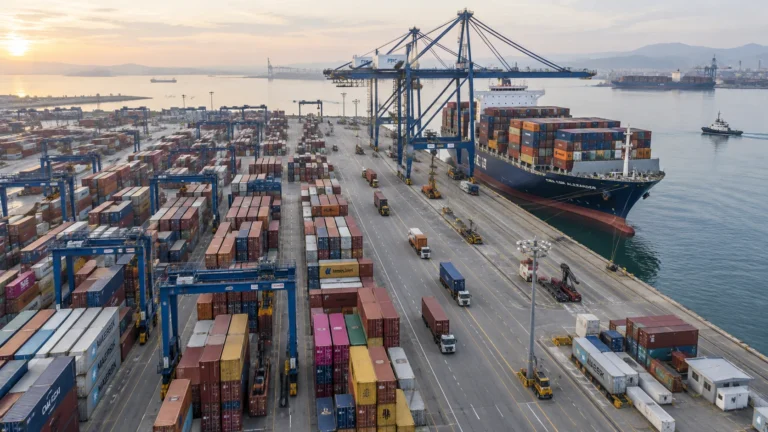
Shipping to Equatorial Guinea works by sea freight to the ports of Malabo and Bata, by air freight to the airports of the same two cities, or by express courier for documents and small parcels. The country is split between Bioko Island, where the capital Malabo is, and the mainland region around Bata, so the entry point should match where the goods are going.
Every sea shipment needs an electronic cargo tracking note (ECTN) before it arrives, and every shipment clears customs with matching commercial documents. Below: which route fits which cargo, the documents, duties and taxes, clearance times and what to do if you have no local company.
- Sea freight arrives at Malabo or Bata. Pick the port on the same side as the delivery site: Malabo for Bioko Island, Bata for the mainland.
- An ECTN is required for every sea shipment and has to be validated before the vessel arrives.
- Import duty follows the Central African Economic and Monetary Community (CEMAC) common external tariff, with value added tax (VAT) at 15% on top.
- Courier services suit documents and samples. Commercial cargo still goes through full customs clearance.
- Customs needs a local importer named on the declaration. Without a company in the country, an importer of record can act in that role.
Ways of Shipping to Equatorial Guinea
There are three ways to ship goods into the country: sea freight for heavy and bulky cargo, air freight for urgent or high-value goods, and express courier for documents and small parcels. The choice depends on weight, urgency and how much the goods are worth compared with the cost of moving them.
| Method | Best for | Entry points | Customs clearance after arrival |
|---|---|---|---|
| Sea freight | Equipment, vehicles, construction materials, full containers | Ports of Malabo and Bata | Typically 7 to 10 days |
| Air freight | Spare parts, medical supplies, urgent project items | Airports of Malabo and Bata | Typically 2 to 3 days |
| Express courier | Documents, samples, small parcels | Handled by the courier network | Handled by the courier |
Clearance times apply once the documents are complete and correct. Transit time before arrival depends on where the goods ship from and the service booked.
Ports and Airports: Malabo, Bata and Luba
Sea freight is discharged at Malabo on Bioko Island or at Bata on the mainland. Air freight lands at Malabo International Airport or Bata Airport. Choosing the entry point on the same side as the delivery site avoids a second sea or air leg between the island and the mainland.
- Malabo (Bioko Island). The capital, with the main government offices and the base for many oil and gas companies. Goods for sites on Bioko should arrive here.
- Bata (mainland). The largest city on the mainland. Goods for the mainland region should arrive here.
- Luba (Bioko Island). A third port on Bioko that also receives sea cargo under the same ECTN rule.
We clear goods at the ports and airports of both Malabo and Bata and deliver to site on Bioko and on the mainland.
Documents You Need
A shipment needs a commercial invoice, a packing list, a bill of lading for sea freight or an air waybill for air freight, and an ECTN for every sea shipment. Some goods also need a certificate of origin or an import permit. Values, quantities and descriptions must match across all documents.
- Commercial invoice with a clear description, the Harmonized System (HS) code and the value of each item
- Packing list that matches the invoice line by line
- Bill of lading (sea) or air waybill (air)
- ECTN for sea freight
- Certificate of origin, where requested
- Import permit or licence for regulated goods
Most clearance delays start with documents that do not match each other. The full list and the most common mistakes are on our customs clearance in Equatorial Guinea page.
ECTN for Sea Freight
The ECTN (electronic cargo tracking note) is a certificate that declares a sea shipment to the national authorities before it arrives. It is required for sea cargo discharged at Malabo, Bata and Luba. One ECTN covers one bill of lading, and it has to be validated before the vessel reaches the port.
The ECTN is usually arranged by the shipper or the freight forwarder at the port of loading, using the bill of lading, the commercial invoice and the freight invoice. A missing or late ECTN holds up clearance and can lead to penalties. The ECTN is not needed for air freight.
Courier Services to Equatorial Guinea
Express courier services are available for documents, samples and small parcels. DHL Express, for example, operates in the country through its own company based in Malabo. Courier shipments still go through customs, and duties and VAT apply to goods in the same way as for freight.
A courier is the right choice for contracts, tender documents, product samples or a small spare part needed urgently. For machinery, pallets or project cargo, air or sea freight with a local clearing agent is usually the practical option, because courier services limit the weight and size of each piece.
Import Duties and Taxes
Import duty follows the CEMAC common external tariff, with rates of 0, 5, 10, 20 or 30% depending on the HS code of each item. VAT at the standard rate of 15% is added on top. Duty is generally calculated on the CIF value: the cost of the goods plus insurance and freight to the port of arrival.
Because the HS code decides the rate, a wrong code on the invoice changes the cost and can delay clearance. We confirm the classification at the quote stage and estimate duties and taxes before anything ships. Embassies, aid organisations and some projects can import under a duty exemption, and equipment that leaves after a project can come in under temporary import.
How Long Shipping Takes
Delivery time has two parts: transit to the port or airport, and customs clearance after arrival. Transit depends on the origin and the service booked. Clearance typically takes 2 to 3 days for air freight and 7 to 10 days for sea freight, once the documents are complete.
The usual causes of delay are values or quantities that differ between the invoice and the packing list, a missing or late ECTN, vague descriptions or wrong HS codes, and import permits requested only after the goods arrive.
Shipping Without a Local Company
Goods can be shipped without a local company through an importer of record: a registered local company that is named on the customs declaration and imports the goods in its own name. Customs needs a local importer, so a foreign supplier cannot clear the goods alone.
Our registered company in Malabo acts as importer of record, clears the goods and delivers them to site. Buyers in Malabo and Bata can pay us in Central African CFA francs, and we pay their suppliers abroad in US dollars or euros. If you have not chosen a supplier yet, our sourcing services team can find one to your specification. For the legal side of the role, see what an importer of record is.
Example: Shipping a Generator from the UAE to Bata
This is an illustrative example of how a typical shipment runs, not a description of a specific client project.
A contractor needs a diesel generator delivered from the United Arab Emirates (UAE) to a construction site near Bata and has no local company.
- Quote. The contractor sends the generator specification and the site address. The quote covers the freight, the estimated duty under the generator’s HS code, VAT and delivery to site.
- Documents. Before loading, the commercial invoice, packing list and bill of lading are checked against each other, and the ECTN is arranged for the bill of lading.
- Sea freight to Bata. The generator ships to Bata, the port on the same side as the site, so no transfer from Bioko is needed.
- Clearance. Our company in Malabo is named as importer, files the declaration and pays the duty and VAT locally. Sea freight clearance typically takes 7 to 10 days with complete documents.
- Delivery. The generator is delivered to the site against a signed delivery note.
Shipping FAQ
Sea freight for heavy or bulky cargo, air freight for urgent or high-value goods, and express courier for documents and samples. For any route, choose the entry point on the same side as the delivery site: Malabo for Bioko Island, Bata for the mainland.
Ship to Malabo if the goods are going to Bioko Island and to Bata if they are going to the mainland. Moving cargo between the island and the mainland after arrival adds another sea or air leg, more cost and more time.
Yes. Every sea shipment to Malabo, Bata or Luba needs an ECTN validated before the vessel arrives, one for each bill of lading. Air freight and courier shipments do not need one.
Yes. DHL Express has its own company in Malabo and suits documents, samples and small parcels. Goods sent by courier still clear customs, and duty and VAT apply.
Duty depends on the HS code of each item under the CEMAC common external tariff, at 0, 5, 10, 20 or 30%, generally on the CIF value. VAT at 15% is added on top.
Yes. A local importer of record can be named on the customs declaration and import the goods in its own name. Our registered company in Malabo does this and delivers the goods to your site.
Planning a Shipment to Malabo or Bata?
Send us the invoice, packing list and delivery site. We check the documents and come back with the route, the estimated duties and a price to site.